Monday, April 12, 2010

Tunis, Tunisia

Friday

For a change, our flight from London was at a reasonable hour, so there was no need to get up and catch a cab at 4am this time around. We had a leisurely start to the day and left home around 2pm to head for Heathrow for our 5pm flight to Tunis. The flip-side, of course, was that our flight was packed full of screaming children, some of whom liked to kick the back of the seats in front of them for two hours solid… Fun times!

After an hour’s delay in leaving London, we arrived in Tunis about 8.30pm and headed for Les Ambassadeurs Hotel. We did not have to wait long for the first attempted scam, as our taxi driver at the airport tried to charge us 20 Tunisian Dinars for the short journey. We had read that a fair price was between seven and 10 dinars, so we didn’t get in the cab until he agreed on 10. Even then he was trying to get an extra two dinars when we got out at the hotel.

We checked in to the hotel and met Kristen and Neena, who had arrived earlier, for a drink in the lobby. Everyone was pretty tired, so we called it a night pretty early.

Saturday

On Saturday morning we met the girls and had a buffet breakfast in the hotel lobby. It was pretty good, if a little odd, as they served peas and carrots as one of the options! But they also offered freshly squeezed orange juice, which was really good!

After breakfast we caught a taxi into the Medina (old town) of Tunis to explore the souqs (markets). Taxis in Tunisia (when charged the correct amount – the trick is to insist that they use the meter!) are extremely cheap. A 10 minute ride through the city cost about 4 dinars, which is roughly £2. So it was by far the most efficient way to travel!

Tunisia is the northernmost country in Africa. It is bordered by Algeria to the west, Lybia to the south-east and the Mediterranean Sea to the north and east. Its size is around 165,000km sq and its population is 10.5 million. The south of the country is composed of the Sahara desert, with much of the remainder consisting of fertile soil and 1,300km of coastline. The official language is Arabic, but French is very widely spoken, particularly in the north.

The earliest known history says that Tunisia was inhabited by Berber tribes. Its coast was settled by Phoenicians as early as the 10th century B.C. The city of Carthage, on the outskirts of Tunis, was founded in the 9th century B.C. Carthage was eventually conquered by Rome in the 2nd century BC, a turning point which led to ancient Mediterranean civilization having been influenced mainly by European instead of African cultures. Around the end of the 7th century the region was conquered by Arab Muslims, who founded the city of Kairouan which became the first city of Islam in North Africa. Later the Ottoman Empire ruled the area, and from 1881 to 1956 the country was under French colonisation. In 1956 Tunisia gained independence.

Once we got our bearings, we made our way to the souqs and we had a fantastic time wandering through, looking for treasures! Overall, the quality of the items for sale in the souqs looked better than what we had seen in Egypt and everything was much cheaper than in Egypt. We had been warned about the Tunisian men being very sifty and they did not disappoint. However, they were fairly harmless in Tunis; it was much worse further south in the country!

After exploring the markets and haggling over a few items, we tried to visit the Great Mosque of Al-Zaytuna. Unfortunately tourists are not allowed to go inside the mosque, but were able to go up to a viewing platform and look over the internal courtyard and the minaret (tower). It was very beautiful, as were most of the buildings in Tunis.

After checking out the mosque, we went for another spin of the souqs and then we went a little off the beaten track and explored some more narrow alleys of the Medina, including checking out the restaurant where the girls had booked us in for dinner for that night. One of the fascinating things about Tunisia is its beautifully decorated doors. The door to our restaurant was bright yellow with lovely black domed patterns all over it (see photo below). These elaborate doors are a common occurrence right throughout the country, usually in blue or yellow.

We grabbed a cold drink and sat by a beautiful water fountain and garden in the middle of several government buildings in the Medina, plotting our next move, and then we grabbed a taxi across the city to visit the Bardo Museum.

The Bardo Museum is housed in a former palace of the provincial governors. It is arranged into sections covering the Carthaginian, Roman, early Christian and Islamic eras. The highlight is the Roman section, where entire walls and floors are paved with mosaics from the 2nd century BC to the 7th century AD, many of which almost intact.

It was a lovely day in Tunis – sunny all day and it got quite hot in the afternoon. On arrival at the Bardo Museum, we grabbed some snacks and then checked out the mosaics! Unfortunately, the Islamic area and some other parts of the museum were closed for renovations when we visited, but we still got to see some really interesting stuff.

After our museum visit, we got a taxi back across town to the Nouvelle Ville (new town). It is here that the French influence is most prevalent. The main street of the Nouvelle Ville, the Avenue Bourguiba, is wide and straight and reminded us a little of the Champs-Elysees in Paris. Staying with the French theme, we wandered along the Avenue Bourguiba until we found the CafĂ© de Paris, where stopped and had a late lunch outside in the sun. Tim was tricked by the cheap prices and confusing menu. It appeared that the main dishes pretty much just came on their own, with no sides, since the sides were listed separately and the menu didn’t explain what each dish came with. So Tim ordered the grilled chicken and the cous cous fermier as a side dish. As it turns out, the cous cous fermier is a massive mountain of cous cous, with half a chicken and a whole bunch of roast vegetables on top (definitely not a side dish) and the grilled chicken comes with chips and salad (no sides required). Still, he battled valiantly through one and a half mountains of food before retiring.

After lunch, we walked/rolled down the remainder of the Avenue Bourguiba, which took us back to the Medina. We had one last wander through the souqs and then headed back to the hotel to meet up with Lauren, who had arrived from London on an afternoon flight. We had some drinks and snacks in the hotel lobby and then got ready to go out for dinner.

The restaurant was beautifully decorated inside, with patterned designs all over the walls and ceiling. The food was fantastic, but the entertainment (provided by us) was even better. After a few drinks (mainly of delightful Tunisian wine), the cameras came out and we decided to have a contest to see who could do the most ferocious tiger impersonation. Megan went first and did a very fine tiger (she has had years of practice of performing the actions to "Eye of the Tiger"). Neena's tiger was pretty good, while Kristen's was more like a friendly kitten than a tiger and Tim's was a bit too much claw-orientated. So Megan was leading the contest when Lauren returned from the bathroom (having not witnessed the previous tiger impersonations). We told her what was required and after a few seconds of mental preparation, Lauren unleashed a ferocious tiger on the table that had the waiter terrified and the rest of us laughing so hard it hurt. (See separate blog entry following this one with pictures of our tigers - you be the judge).

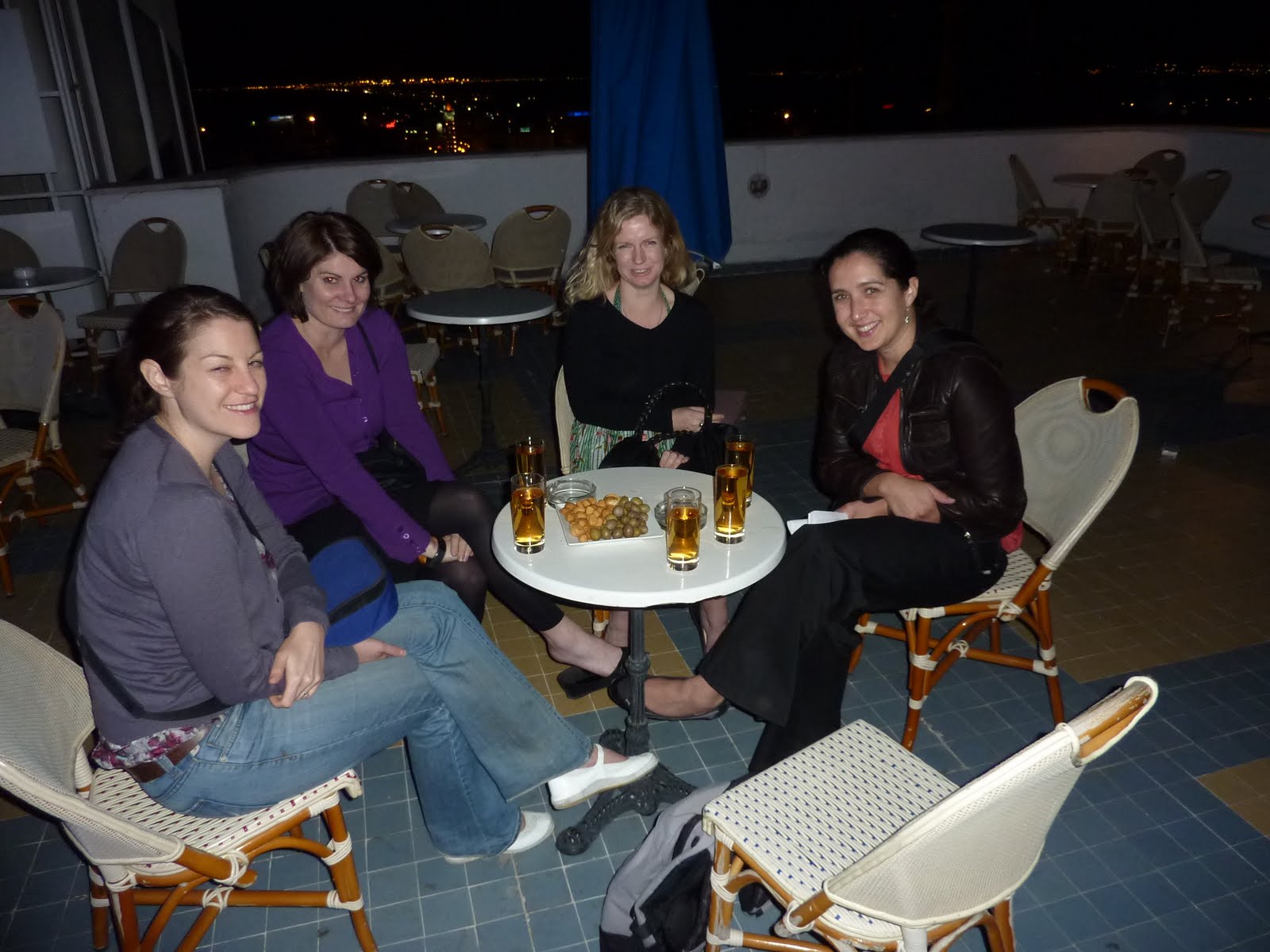
After dinner we visited one of the few bars in Tunis that serves alcohol after dark, a lovely hotel roof-top bar called "Bar Jamaica". Our initial reaction was that there were not many women in the bar, but after Tim popped his head in the door, he confirmed that there were actually no women at all in there. There were about 40-odd men and a thick haze of cigarette smoke. We decided to sit outside to avoid the smoke and the sifty men. Then the waiter told us that there was no beer, despite everyone else in the bar appearing to be drinking beer. Tim pointed this out and asked for a beer and the waiter scampered away to "check" and returned with five beers - it appears that men order on behalf of the women-folk in Tunisia.

As it was getting cold, we braved it and moved inside, at which point approximately 38 of the 40 men swivelled around so that they were staring directly at us, as we sat in the middle of the bar and sipped our warm beer. There is not even any subtlety; the men just stare at Western women and don't try to hide it. We were asked where we were from by about several different men, including our favourites, who were two particularly sifty men at the bar. Lauren told them we were from New Zealand and they replied, very excitedly, that they were from Tunisia. Shock horror! None of us cared anyway. After a while, we were sick of being stared at like animals in a zoo, so we headed home, sadly just as a rotund man was laying down the gauntlet on the dance floor.

Sunday

Easter Sunday did not start well, as Neena had been sick in the night and Megan was sick all morning. The plan was to head out to the seaside village of Sidi Bou Said, on the outskirts of Tunis, before heading down the coast to Port El Kantaoui in the afternoon. Megan decided to stay behind at the hotel, but the rest of us continued on to Sidi Bou Said after breakfast.

We had a really nice taxi driver, who explained to us that all taxi drivers were legally obliged to use the meter in the taxis rather than simply quote an inflated price to unsuspecting tourists. All good in theory, but most of the taxi drivers obviously don't care for the law. On the way to Sidi Bou Said we drove through Carthage, which is Tunisia's best known archaological site, with many Roman ruins scattered throughout the large suburb of the capital. We also drove past the massive Presidential Palace in Carthage, which seemed to go on and on and on, and was very heavily guarded! The president, Ben Ali, took over in 1987 following a strange sort of coup, where the previous president was judged to be "medically unfit" to continue in office. Ben Ali has been president ever since and it appears that it is an effective dictatorship, in the guise of a procedural democracy. The president has lovely banners with huge photographs of himself hung on the sides of buildings and on the roadside throughout the country. Still, his palace looked pretty nice.

Sidi Bou Said is invariably described as Tunisia's prettiest village. It somehow shrugs off its two and a half centuries as a tourist trap and remains a place of charm. It is a favourite retreat for wealthy Tunisians as well as tourists, and yet it did not seem overly crowded. The village is perched on a hilltop overlooking the Mediterranean Sea and it is packed full of white houses with bright blue doors and windows (see photos below), which all served to give it a very Greek feel.

We wandered the pretty streets of Sidi Bou Said snapping away on our cameras and gradually made our way into the centre of the village. Kristen and Lauren ventured off to visit a tiles/mosaics museum, while Tim and Neena grabbed a seat at a cafe and felt sorry for themselves (Neena was still feeling the effects of her food poisoning and Tim had started to feel sick by this stage too). We had a hilarious conversation in French with the waitress - we asked for some drinks (boissons) and she kept telling us over and over that they did not serve fish (poissons) and that we could have pizza or salad instead. The last thing either of us wanted at that stage was fish!!! We eventually resorted to following her inside and pointing to a can of lemonade in the fridge.

We met up with the others a bit later and called our friendly taxi driver to come back and collect us. Tim made Sidi Bou Said slightly less pretty (the gutter at least) while we waited, but we all managed to survive the drive back to the hotel with no further sickness. As we got back in to Tunis, our taxi driver pulled up outside a patisserie and re-emerged moments later with a box full of Tunisian sweets for us - he really was a nice guy, shame that he was the exception rather than the rule!

Megan was feeling a little better by the time we arrived back at the hotel, but Tim felt rough by this stage. We had a car booked to take us from Tunis down the coast to Port El Kantaoui (about 130km away) at 2pm, and with sick bags in tow, off we went. Luckily we had a pit stop halfway there, which came at just the right time for Megan, and we arrived in Port El Kantaoui before 4pm.


Place de la
Victoire


Souq


Neena hunting
treasure


Tasty
treasure


"Hey come in,
just look, no
hassle"


Bear at
the Great
Mosque of
Al-Zaytuna


Great
Mosque
again


Medina


Kristen,
Neena and
Megan


The door of
our restaurant!


Pretty garden
in the Medina


Bardo
Museum


Another
awesome
door


Avenue
Bourguiba,
Nouvelle
Ville


Church of St
Vincent de Paul
in Nouvelle
Ville


Drinks at
Bar Jamaica


Sidi Bou Said
door


Sidi Bou
Said


Ditto


And again...


Shops in
Sidi Bou
Said

Monday, January 25, 2010

Stoke City v Arsenal - FA Cup

On Sunday we got up early and caught the 8am Arsenal Supporters' Bus from the Emirates Stadium up to Stoke-on-Trent to see Arsenal's 4th round FA Cup match against Stoke City. Stoke-on-Trent is situated in Staffordshire, about midway between Birmingham and Manchester. The bus trip took around three hours, although on the way up we had a comfort stop, which added some time.

We arrived in lovely Stoke-on-Trent around 12pm and thankfully the bus went straight to the Britannia Stadium. We had a couple of beers and a pie under the away fans' grandstand while the 4,800 Gooners warmed up for the match with a few chants.

Just four days earlier Arsenal had gone top of the premier league with a 4-2 victory over Bolton. While it would be fantastic to win the FA Cup, we have far bigger fish to fry this season - we have to focus on the premier league and the European Champions League, where we are in solid positions. With a raft of injuries and four massive premier league fixtures coming up in the next three weeks, manager Arsene Wenger had little choice to but to field a B team at Stoke. There were nine changes from the team that beat Bolton in midweek. Stoke are a decent side, particularly at home, and they play a very tough, abrasive brand of football - not always pretty, but usually effective.

The Gooners were in fine voice with the typical away-game chants coming out early - old favourites such as "We fill our stadium" in reference to the hundreds of empty seats in the home fans' section and "You've only come to see the Arsenal". There was also a lot of excitement around the return to Arsenal of defender Sol Campbell. Campbell last played for Arsenal in 2006 but just re-signed this month and this was his comeback match. He was pretty solid and you could see his experience and calmness having an influence on some of the younger players.

Sadly Stoke took the lead in the 2nd minute and had the better of the first half before Arsenal drew level just before half-time through a free-kick. Spirits were high in the away section as the second half got under way. It was a cracking match played at a pretty high pace in the second half. The last thing Arsenal wanted was a draw, which would have meant a replay in an already crowded fixture schedule, so Wenger took a gamble on 65 minutes and used all three of his substitutes in one go, bringing on some more experienced attacking players.

Unfortunately, as we pushed forward looking for a crucial second goal, we were caught on the break and Stoke hit the lead. They then scored a late third and won the match 3-1, knocking us out of the FA Cup. It was a slightly disappointing result, but it was always on the cards with the team we fielded. And it now means we can firmly focus on the premier league. Stoke played well and deserved to win, so we can have no complaints.

The bus trip home was pretty quick, with no stops, although we had to listen to a few disgruntled Gooners criticise the team selections and a few of the players...it was obvious a few fans cannot see the bigger picture! You can't play the same 11 guys for 60 games in a season!

Still, despite the loss, we had a good day - away games are a lot of fun. And we saw another special part of England...don't think we will be returning to Stoke...


Tim at
Britannia
Stadium


Inside the
Stadium


Megan before
the match


Arsenal
in blue


Wenger not
looking
happy


Fabregas
taking a
free kick


Dejected
Gunners
Eduardo
and
Fabregas


Friday, January 15, 2010

Thriller - Live

On Thursday night we went to the Lyric Theatre in London's West End to see "Thriller - Live", the musical celebrating the music of the Jackson 5 and Michael Jackson. We had the added delight of 'all you can eat' Chinese buffet for dinner beforehand.

The show was brilliant. It was over two hours of non-stop hits, starting with the early years of the Jackson 5 and going right through to MJ's massive hits of the '80s and '90s. The little boy who played the young Michael Jackson was absolutely brilliant. He must have been about 10 or 11 years old and he had so much confidence. His singing and dancing was superb.

The adult MJ role was played by four different people and they were all great. One in particular must have worked as a professional MJ impersonator for years, because he was insanely good. He did a solo Bille Jean performance and he was exactly like the man himself. It was unreal. He had all the mannerisms, all the dance moves including a flawless moonwalk! Billie Jean was definitely our favourite, but Smooth Criminal was outstanding too.

The team of back-up dancers was amazing as was the awesome multi-media effects. Definitely worth a look even if you're only a little bit of a fan!


Saturday, January 2, 2010

Porto, Portugal

Sunday

On Sunday we had to get up at the outrageous time of 7.30am in order to get in our brilliant hotel breakfast, check out and get ourselves across town to the railway station to catch our 9:30am train to Porto. The journey from Lisbon to Porto takes around three hours. Like all of the Portuguese public transport we used, the train was clean, comfortable and inexpensive. Good work Portugal!

However, we did encounter an increasingly common phenomenon – many of our fellow passengers spent an enormous amount of time gazing around with confused looks on their faces and stumbling over each other trying to locate their pre-assigned seats. We have observed similar behaviour in London theatres, American sporting events and in other parts of Europe too. Seriously people, the seats are set out in numerical order, it’s really easy. People were walking back and forth wondering where on earth seat 89 could be - shock horror, it was obediently sitting between seats 88 and 90... It's not as if they are arranged at random!

Anyway, despite this kerfuffle and a few more shady characters with a keen eye for handbags and wallets, we successfully arrived in Porto. We made our way to the Quality Inn, which was sadly quite a step down from the champagne and before-bed chocolates luxury of the Sofitel in Lisbon. Sigh. However, we settled in and then stepped out into the Porto afternoon to do some exploring and to watch Arsenal beat Aston Villa 3-0!

Porto (which is also known as Oporto) is the second largest city in Portugal and is located on the banks of the Douro River, close to the west coast in northern Portugal. It has a population of around 220,000, but the city is fairly compact and we were able to comfortably explore it on foot. The main city centre is a UNESCO world heritage site, and is full of winding cobblestone streets and Gothic churches that spill down steep hills to the Douro River, which of course makes the walk back up to the centre of town a bit of an effort! There are loads of cafes, restaurants and bars along the waterfront, which must be particularly buzzing in summer, given they were pretty cool even in the middle of winter. Portugal is probably a summertime country really. There are amazing beaches, particularly down south in the Algarve region, and even in the cities where we visited, we got the feeling it would have been great in hot, sunny weather.

From the waterfront, you can look across to the south bank of the river to the Vila Nova de Gaia area, which plays host to all of the port houses. Vila Nova de Gaia can be reached by a short walk across the impressive Dom Luiz I Bridge. We planned to spend a large part of the following day on the south bank so for the rest of Sunday, we confined ourselves to exploring what the north side had to offer. The highlights of our exploration were the Se Cathedral, complete with a Manueline pillory in the courtyard in front of the cathedral, and the Parisenne-like Avenida dos Aliados, which is a sloping boulevard packed with amazing buildings down either side and a central grass and pavement area, complete with a lovely water fountain.

Finally, we wrapped up the day by sampling some local cuisine at a downtown eatery and turned in early - by this stage we were becoming accustomed to 11 hour sleeps!

Monday

We started Monday with a reasonable breakfast at the Quality Inn, before heading off on our own personal walking tour of Porto, as devised by the Lonely Planet. Monday was pretty grey and ominous looking but we took our jackets and umbrella and braved the conditions anyway. Our walking tour took us through the lovely and lively streets of Porto and we stopped to check out places of note along the way.

Our first stop was the Torre dos Clerigos, a magnificent bell tower for the Clerigos Church (there are a lot of churches in Porto!). The tower is 76m high and can be seen from most spots in the city, making it one of Porto's most famous symbols. We declined to climb the 225 steps for the amazing panoramic views of the city that our guidebook promised us, mainly due the miserable grey day which would have wrecked the views anyway, and also because we were a little climbed out after a year of tackling bell towers and cathedrals all over the Europe.

As we walked past the Clerigos church behind the tower, the heavens opened and it absolutely chucked it down for about 5 minutes. We ducked into the nearest shoe shop (another thing that Porto has way too many of - one street near our hotel had 19 shoe shops on it - out of about 50 shops total) and pretended to be interested in a pair of boots while a grumpy looking shop-keeper hovered over us. As the rain eased, we decided against buying the boots and continued on our merry way.

The next significant landmark on our tour was the Sao Bento railway station - Porto's most famous train station, renowned for its beautiful tile panels on the walls, which depict scenes from the history of Portugal. Further down the hill we again had to run inside to avoid a rain shower, although this time we happened to run into the Port Wine Institute, where we checked out the gift shop and watched part of a video on how port is made. In truth the Port Wine Institute was boring and we knew we had a lot of port information coming our way later in the day when we visited the port houses. So we carried on to the old Porto stock exchange building, where we admired the beautiful lobby and decided against joining a tour to see the rest of the building.

Instead, we scampered down the street to the Sao Francisco church, where we did do a tour. The Sao Francisco church is the most prominent Gothic monument in Porto. The Franciscan Order began building a church on this site in 1223 and later expanded the church, with this new structure being completed in 1425. The church is famous for its amazing Baroque interior. Over 200kg of gold encrusts the high altar, columns and pillars - truly breath-taking. The highlight of the entire church, however, is the Tree of Jesse - a gilded and painted wooden carving of a tree (1718-21) showing Christ's genealogy. Its branches and trunk, sprouting from a reclining Jesse, support a dozen expressive figures, culminating in Christ at the top of the tree. We also visited the catacombs and the treasury under the church.

Our next stop was the birthplace of Henry the Navigator, which is now the home of a small and unexciting looking museum. So we pretty much kept on walking and hit the waterfront of the Douro. We walked across the Dom Luiz I Bridge to Vila Nova de Gaia and we strolled along the south bank, where the Lonely Planet encouraged us to "find a table outside a cafe and watch the world go by". Clearly, the Lonely Planet has been to Porto in sunnier times. However, we revised the advice to mean "dive into the nearest port house" and were well satisfied with our choice - Calem - which turned out to be one of the most visited port houses in Porto.

As such, they provided a very professional and interesting 30 minute tour on the history of their company and the making of port wine, followed by tastings of two of their classic ports. It turns out that we did not know much about the intricacies of port. However, over the next couple of days we received a good understanding of how port is made, how it is different to other wines and the different varieties it comes in: ruby, tawny, white and vintage.

We learned that all port comes from grapes grown in a small area on the banks of the Douro River around 100km east of Porto. There, the stony soil (which has been blasted and shaped into terraces) creates an ideal environment where the vine roots can grow deep into the ground where they are protected from the most extreme heat by the stone, which in turn stores and releases the heat through the cold nights to keep the vines at a constant temperature. Once the grapes are harvested and squashed down into the pre-fermented base liquid, the fermenting process is allowed to continue only part-way (not entirely, as in the case of other wine) then it is halted with the addition of a high alcohol brandy. This makes the "fortified" wine, which retains lots of sugary sweetness (having only been partly fermented) with a higher than usual alcohol content, because of the brandy. One of our favourite parts of the port "story" is the old fashioned boats that were used for centuries to transport the casks of port from the Douro Valley to the port houses we visited on the south bank in Porto. The rickety old sail boats (stocked with old wooden port barrels) are still used today to give tourists rides along the river (see photos below).

After Calem, we wound our way up the hill to Taylor's, a stoically English port house and very pretty at that, with vines trailing all over buildings and several peacocks (or peahens, more precisely) and chickens wandering around the gardens behind the buildings. Taylor's generously offered two free tastings and a free tour of the cellars if we were so inclined, which we decided against after just seeing the same at Calem. We were impressed with what we tasted and made our first purchase, a 2003 late bottle vintage. After all that excitement, it was time for a long lunch and some more photos of river boats, before rounding off our port tour with a visit to the oldest house of all, Kopke, established in 1638. By then we were struggling to get through any more tastings (port, at the best of times, being a bit overpowering and rich) although the free chocolates that Kopke kindly provided were certainly appreciated. We purchased another two bottles of port at Kopke - so delicious and so cheap.

We finished off our day with dinner at a restaurant near to our hotel, called Cacuna, which we would recommend to anyone visiting Porto. We found it a bit hard to get away from grease and traditional meat/cheese/bread dishes in Portuguese restaurants so we were very happy to find some healthier fare at Cacuna!

Tuesday

On our last day in Porto we had planned to take a river cruise along the Douro, however, the weather conspired against us as the rain had meant the river level was too high for boat cruises. Instead, we did a spot of souvenir shopping and a bit more sight-seeing. Despite the high river levels, the weather was actually better than it had been the day before. It started cloudy and grey (but dry) and by afternoon it was actually sunny and warm.

To help us get around we decided to buy day passes for the metro system, which we could also take out to the airport later that afternoon. However, this simple exercise came with a few surprises, starting with the discovery that the ticket machines would only permit us to deposit the required 11.70 euros in coins, not notes. Now, in London, home of useless shrapnel, this wouldn't be much of an issue, but it turns out Portugal runs on a tight coin allowance. Everywhere we had been, we had been asked for exact change, or an extra 1 or 2 euros so change could be given in notes rather than coins, so we had ended up rather coin-poor. After undertaking some strategic kit-kat purchasing at a nearby shop, we managed to obtain the required fistful of coins to buy our metro tickets. Back at the ticket machine, we were joined by a sifty looking man who stared at us very intently while we used the machine...and made a quick grab for the tickets immediately on printing. Luckily Tim is always on alert for such shenanigans and moved at ninja-quick speed to fend him off - honestly! The man jibbered some Portuguese and made another grab for our tickets, so Tim unleashed some fury on him and he eventually left. Exciting times on the metro.

The metro took us across the river to the south-side to the foot of a hill, the top of which houses an old monastery which is very picturesque despite now being used by the military. We walked up the hill under the cold stare of a machine gun-wielding soldier and admired a fantastic, if rather misty, view of Porto. Many photos ensued! Afterwards, we made our way back down to the river.

As the river cruise was off, we consoled ourselves by taking a tour of the one port house we hadn't been able to tour the previous day, Sandemans. It turned out to be an excellent tour, and we were particularly charmed by the Sandemans mascot - the "Don". The Don looks a bit like Zorro in a black cape and hat and was introduced to the public in the 1920s. He features on the bottles, casks and advertising and was apparently one of the first trade marks registered in the UK. Megan got quite a kick out of all the intellectual property talk! To emphasise the brand, our tour guide wore the costume (see below) and there were life size cut-outs of the Don lurking in many corners of the cellars during the tour. After the very interesting tour, we sampled some Sandemans port. Having purchased three bottles of port the day before, we thought we had enough port to take home, although the Sandemans port was so delicious we had to buy two more bottles.

Back across the river we had a challenging time trying to order a toasted sandwich at a waterfront cafe, as the owner was good heartedly intent on serving us something else - a Portuguese "special" that looked like a sandwich with cheese, ham and beef, lying in a kind of weak tomato soup. He was determined to sell us (and an American family) this special, which also happened to be the most expensive thing on the menu - he even brought it to our table for us to admire. We eventually got what we were after, although he seemed rather downcast over what we had missed out on.

After some shopping, we stopped in at a cake shop where we had a much simpler experience over hot chocolate and custard tarts before heading back to the hotel to pick up our bags. We took the metro to the airport - this time without incident - and boarded a flight with the good people at TAP Airways (who have very trendy uniforms!). We got home 30 minutes early - surely a record for us heading into Heathrow. We had packed the five bottles of port as carefully as we could in our checked on luggage. There was a slight moment of panic at Heathrow when Tim's suitcase arrived squashed and soaked, but thankfully this was due to the London rain, and not leaking port!

That ended another fantastic year of travels and the country tally is climbing:
Megan 35
Tim and Bear 32


Church next
to our hotel


View down
Vila Nova
de Gaia


Statue in
street


Tiled walls
in Sao Bento
train station


Se Cathedral
and pillory


Douro River
and Porto


Dom Luiz I
Bridge by
night


A square by
the waterfront


Sandemans
port house


Taylor's
port house


Bird's eye
view over
Porto


Old port
boats


Sandemans
cellars


The Don and
our tour guide


Town Hall
Avenida dos
Aliados


Country
number 32