Monday, January 10, 2011

Birmingham City v Arsenal

New Year's Day

We decided to start 2011 with a bang, so after having a massive, much-needed sleep-in, we headed down to Euston train station and caught the train up to Birmingham. We had tickets to see the Birmingham City v Arsenal premier league clash. Thankfully it was a 5.30pm kick-off...not sure if we would have made the lunchtime kick-off time!!!

It was cold and wet in Birmingham and the city didn't look particularly exciting. We stopped in at a pub en route to the stadium and it was a touch on the scary side. It looked a bit more like a drop-in centre for homeless people and there were a couple of very drunk guys busting some moved on the otherwise empty dance floor (at about 4pm). Cracking. We had a nervous drink and then carried on towards the stadium. There was a huge contingent of Arsenal fans at the game and the chanting was as awesome as ever at an away game, drowning the almost silent home fans.

Birmingham are very tough to beat on their home patch, having already beaten Chelsea and drawn with Manchester United there this season. However, Arsenal started brightly and took the lead after about 20 minutes. Things got better after halftime, as we went 3-0 up around the hour mark, which brought more hilarious chants from the Gooners. Arsenal spent the last 20 minutes of the game entertaining the fans with outrageous tricks and flicks and, while the game ended 3-0, it could have been plenty more.

The train ride back to London after the game was entertaining, as we were amused by a group of rowdy young Gooners. Happy days. We love away games! Arsenal are starting to look very strong now and if the key players stay injury-free, we should have a great chance of reining Manchester United in at the top of the league.

Happy New Year!


Megs at
St Andrew's
stadium


St Andrew's


Monday, January 3, 2011

Vienna, Austria

Boxing Day

On arrival in Vienna, we were much better at working out the underground system this time and we found our way to our hotel no worries. After checking in, we walked the short distance to the city centre. It was insanely cold, even with our many layers of clothing on. Our walk included a crossing of the Danube, which looked very pretty with lots of lights from boats and city buildings reflecting off the water. Vienna looked amazing with all of its Christmas lights, awesome shops and people everywhere.

We found a German beer garden-style restaurant and tried out their wheat beer, which was very nice and then we ordered some dinner. Megs ordered potato soup and calamari. Tim had the local specialty, the "giant wiener schnitzel", and it was seriously enormous - see photo below. But it was delcious and between us we managed to devour it.

Monday

On Monday we were greeted with blue sky and sunshine, but it was still very, very cold - a high of about -5 degrees. After breakfast in the hotel, we realised that the Kunsthistorisches Museum was closed on Mondays, so we changed our plans and Megan led us on a walking tour of the city centre of Vienna.

Austria is a landlocked country of around 8.3 million people in central Europe. It is bordered by Germany and the Czech Republic to the north, Slovakia and Hungary to the east, Slovenia and Italy to the south and Switzerland and Liechtenstein to the west, and it is shaped a bit like a chicken drumstick. The territory of Austria covers 84,000 sq km. Its capital and largest city is Vienna, with more than 1.6 million people. The official language of Austria is German. Austria is one of the richest countries in the world, with nominal GDP per capita of close to $44,000.

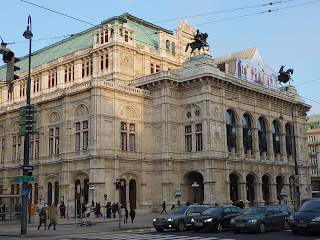
Our walking tour began outside the State Opera House, where we would be returning later in the day for a guided tour inside the opera house! We continued past the Albertina art gallery and the Monument to Anti-fascism and arrived at Stephansdom (or St Stephan's Cathedral) in the middle of the main square in Vienna, Stephansplatz.

Situated in the centre of the city, Stephansdom is the soul of Vienna. A church has stood on this site for over 800 years, but all that remains of the original 13th century Romanesque church are the Giants' Doorway and Heathen Towers. The Gothic nave, choir and side chapels are the result of a rebuilding programme in the 14th and 15th centuries. We had a quick peek inside the huge Cathedral, which was beautiful, before carrying on with our walking tour.

From Stephansplatz we wandered down the busy Graben (a major shopping street), where we saw the enormous Monument to the Plague and St Peter's church, which was also beautifully decorated inside, before we hit the Demel bakery. The Demel bakery is a famous pastry shop and chocolatier in Vienna (and now Salzburg, apparently). It was founded in 1786 and was moved to its current building in 1857, where it has remained ever since. We had a look inside at some of the tasty treats before heading on to the Hofburg Palace.

Hofburg Palace has housed some of the most important people in Austrian history, including the Habsburg dynasty, rulers of the Austro-Hungarian empire. It was the Habsburg's principal winter residence and it currently serves as the official residence of the President of Austria. The huge Hofburg complex also contains several museums, a chapel, a church, the Austrian National Library and the Winter Riding School. We walked through the courtyard of the Hofburg Palace, past the building known as the Winter Riding School, which is home to the famous Spanish Riding School, which performs dressage shows there on pretty white horses.

From the Hofburg Palace, we ventured past the Museum Quarter and back along the road to the Opera House, where we had started our walking tour. It was a great little introduction to the centre of Vienna. We had lined up a tour of the Opera House for 2pm, so we decided to visit the Sacher Cafe, one of Vienna's world famous coffee houses. The Sacher Cafe is part of the Sacher Hotel and is most famous for its "Sacher torte" - a secret recipe chocolate cake that was first made in 1832. We managed to get a table fairly quickly and each ordered a slice of the original Sacher torte, along with a hot chocolate (Tim) and a pot of tea (Megan). It was pretty flash inside the cafe. The cake was only OK - a little dry to be honest, but the experience was fun!

The State Opera House opened on 25 May 1869. Built in the Neo-Renaissance style, it initially failed to impress the Viennese. Yet when it was hit by a bomb in WWII and largely destroyed, the event was seen as a symbolic blow to the city. The Opera House re-opened after the bombing in November 1955. Our guided tour of the Opera House went for almost an hour, with the highlights being the Grand Staircase made of marble that leads from the main entrance up to the first floor (embellished with statues of the seven liberal arts) and the opulent Schwind foyer, decorated with scenes from operas and busts of famous composers and conductors. We also learned about the annual opera ball, an extremely high society which opens when the "well-to-do" young ladies dressed in white and their escorts take to the dance floor.

By the time the tour of the Opera House ended, we were a little bit peckish, so we headed to the classy hot dog establishment behind the Opera House and got ourselves a hot dog to snack on. It was a pretty good dog. Then we returned to our hotel to thaw out, re-emerging in the evening, again rugged up like the Michelen Man.

Megan had heard about a cocktail bar at the top of a hotel in Stephansplatz, that has a great view looking out onto the huge Cathedral, so we made that our first stop of the evening. The bar was very busy and sadly the only seat we could get did not have a great view of the Cathedral, but it was a nice bar nonetheless. We then grabbed dinner at a place called the Bettelstudent Restaurant (where the lure of back to back wiener schnitzels was too much for Tim to resist) before settling into the Irish pub along the road from there, which was showing the Arsenal v Chelsea match live. Aside from the cigarette smoke that filled the pub and stunk out our clothes, it was a fantastic night to be a Gooner, as Arsenal hammered their title rivals 3-1!

Tuesday

On Tuesday morning we had our hotel breakfast and checked out of the hotel before tracking down one of Vienna's favourite monuments - the Johann Strauss II monument in Stadtspark (or City Park). The gilded bronze statue, framed by a marble relief made by Edmund Hellmar, is one of the best known and most frequently photographed monuments in Vienna (see photos below). It was unveiled to the public on 26 June 1921. Johann Strauss II (1825-1899) was an Austrian composer of light music, particularly dance music and operettas. He composed over 500 waltzes, polkas, quadrilles and other types of dance music, as well as several operettas and a ballet. In his lifetime, he was known as "The Waltz King", and was largely responsible for the popularity of the waltz in Vienna during the 19th century.

The main event of our last day in Vienna was a visit to the Kunsthistorisches Museum in the Museum Quarter. The Kunsthistorisches (or History of Art) Museum is housed in a magnificent building on the Ringstrasse, opposite an identical magnificent building containing the Natural History Museum, across the other side of Maria-Theresien-platz. The building itself is amazing - it has a beautiful huge marble staircase from the main foyer, with a massive statue of Theseus clubbing a centaur or animal of some description in the centre, flanked by two fine looking lions.

Its collections are based largely on those built up over the centuries by generations of Habsburg monarchs. On the ground floor there is an Egyptian antiquities area (which includes a small blue ceramic hippopotamous aged about 4,000 years) and a Greek and Roman antiquities area (the highlight of which is the Gemma Augustea - a beautifully detailed Roman cameo carved from onyx). On the first floor are halls and halls filled with French, German, Flemish, Dutch and Italian art work.

We were blown away with how good the museum was - we could easily have spent longer there, if not for our feet starting to get sore and our stomachs starting to rumble. We grabbed some lunch on the go from a bakery and then wandered through the pretty streets of Vienna until we stumbled upon the finest of all Viennese coffee houses, Cafe Central.

Cafe Central was opened in 1860 and late in the 19th century it became a key meeting place of the Viennese intellectual scene. One of its most famous regulars was Peter Altenburg, a renowned poet with an awesome moustache, of whom there is now a life size statue in the entranceway to the cafe. In January 1913 alone, Josip Broz Tito, Sigmund Freud, Adolf Hitler, Vladimir Lenin and Leon Trotsky all visited the cafe! There was a more relaxed feel to Cafe Central than Cafe Sacher, although the staff at Cafe Central were still formal and the service was excellent. They had an amazing range of delicious cakes to choose from - coffee and cake seems to be a national passtime in Austria! So we each chose a piece of cake and spent a relaxing hour in the charming Cafe Central.

With time almost up on our Christmas excursion, we walked along some more lovely streets, taking in the beautiful Judenplatz square, which is home to a large Holocaust memorial (photo below). Then we collected our luggage and made our way out to the airport. Thankfully our flight was on time and the trip home was not too painful. Now, three weeks until the next adventure...


Giant
wiener
schnit-
zel


Mozart
Cafe


Stephans-
dom


Inside
Stephans-
dom


Stephans-
platz


Monu-
ment
to the
Plague


Hofburg
Palace


Very
chilly


State
Opera
House


Inside
Opera
House


Opera
House
ballroom


Old guy
pointing


Johann
Strauss II
statue


Kuntshis-
torisches
Museum


4,000
year old
hippo


Theseus
getting
aggressive


Cafe
Central


Delicious
cakes!


Holocaust
memorial


Sunday, January 2, 2011

Bratislava, Slovakia

Christmas Eve

On arrival in Bratislava, we were greeted with rain and wind, not ideal. We caught a taxi from the train station to our hotel, the Falkensteiner Hotel, near the Old Town in the centre of the city. The taxi driver clearly saw us coming and charged us a horrendous €15 for the 1.5km trip, which took a little over a minute. Booooo. However, we had been awake since 2.30am UK time and we just wanted to get to the hotel. We checked in and had an early night, as we were exhausted.

Christmas Day

Needless to say, we had a giant sleep-in on Christmas morning. The idea was to spend Christmas Day and Boxing Day in Bratislava, where we could relax and take things easy before returning to Vienna for two days of sightseeing. We were greeted with falling snow on Christmas morning, so it was indeed a "white Christmas". It was bitterly cold, much more so than it had been the day before. The high must have been something like -3 degrees, if that.

After a solid buffet breakfast in the hotel, we set off (wrapped up like the Michelen Man) to explore the Old Town of Bratislava. Besides the snow falling and the strong, ridiculously icy, wind, the Old Town was lovely. Bratislava is much smaller than its neighbouring central European capitals, Budapest and Prague, but it does have a certain charm to it. It is one of four European capital cities that the Danube river flows through (by chance, we visited all four of those cities in 2010 - Budapest, Belgrade, Vienna and Bratislava).

Slovakia is a country in central Europe with an area of around 49,000 sq km and a population of more than 5 million. It is a land-locked country, bordered by the Czech Republic and Austria to the west, Poland to the north, Ukraine to the east and Hungary to the south. The largest and capital city is Bratislava. Slovakia is a high-income advanced economy with one of the fastest growth rates in the European Union and the OECD, thanks largely to a low flat tax rate (fantastic idea). The end of Communist rule in Czechoslovakia in 1989, during the Velvet Revolution, was followed by the country's dissolution into two successor states. The Slovak Republic and the Czech Republic went their separate ways on 1 January 1993. Bratislava has a population of around 430,000 and is the political, cultural and economic centre of Slovakia.

Slovakia is a predominantly Roman Catholic country, so both Christmas Day and Boxing Day were public holidays, meaning that very little was open while we were there. However, we visited a couple of souvenir shops and we picked up the obligatory fridge magnet and some postcards. We also checked out the Hlavne namestie (Bratislava's main square), which was looking stunning, with a huge Christmas tree in front of the beautiful Old Town Hall at one end and the 1572 Maximilian Fountain covered in Christmas lights at the other end. The main square was also full of little Christmas market stalls, which were sadly empty, as the markets had closed on 23 December.

One of the quirky features of Bratislava's Old Town is a collection of life-size statues scattered throughout the town centre. The "Napoleon's soldier" leaning over a bench in the main square was our favourite, but there is also a workman poking his head out of a man-hole, a newspaper photographer aiming his lens from around a corner and a man tipping his top hat. The Old Town is packed with beautiful Baroque-style buildings and plenty of lively bars, cafes and shops.

We also found the restaurant where we were booked for an evening Christmas dinner. It was on Michalska ulica, close to the enormous and impressive Michael's Gate. Built in the first half of the 14th century, Michael's Gate is the only surviving original gateway to the medieval city. In 1753-1758 its Gothic tower was raised to its current height of 51m by the addition of a Baroque cupola and the statue of the Archangel Michael.

We popped into an Irish pub and ordered some hot chocolates with a shot of Bailey's to warm ourselves up -we were frozen after an hour or two of wandering the town. We then retired to the hotel and had a lazy Christmas afternoon there, out of the snow! Tim ventured out for another look around the Old Town later in the afternoon while Megs had a little nap.

In the evening, we visited a couple of local pubs - the first was very much like somebody's lounge of their house - very cosy and comfortable. We had a drink and some potato chips there before moving on to a pub called Jimmy's. It was much larger and a little more lively. We shared a bottle of bubbly there to celebrate Christmas. As we were leaving, we discovered they had a large room at the back of the pub that was filled with dozens of big soft toy animals...a little bit weird...

We then headed to La Ramblas Spanish tapas restaurant for Christmas dinner. Not your traditional Christmas dinner, sure. But the food was ridiculously delicious and the service was great. We had the "all you can eat" tapas, salads and grill option. It was awesome. We had a bit of salad and then we ordered a selection of grilled specialities including fried calamari, mussels in wine, prawns, chicken nibbles, salted beef and pork strips, washed down with a bottle of Spanish red. After dinner we rolled down the street to the Irish pub, via a spot of moonwalking in the main square, and rounded off the night with another hot chocolate with Bailey's. Yum!

Boxing Day

Boxing Day began with another enormous sleep-in. Unfortunately we woke to the news that Australia had already got themselves into a losing position in the Boxing Day Test in Melbourne. They were bowled out for nothing and England had passed their score for no loss on the first day. Not the exciting Test we had hoped for. And even worse, England was now surely going to retain the Ashes and we have to listen to months of ranting about how brave, courageous and unbeatable the heroic, superhuman gladiators of the England XI are...yawn. There's only one thing worse than a bad loser and that's a bad winner. England tend to be both.

After packing up our things and checking out of the hotel, we wandered up the hill to check out the Bratislava Castle. It was another crazily cold day, but it was not snowing and it was actually clear with a bit of blue sky. The Bratislava Castle is a massive rectangular fortress on a hill above the Danube river in the middle of Bratislava. It provides an excellent view of Bratislava, of Austria and, on a clear day, of Hungary. The Castle dates back to at least 907 AD, possibly earlier. Fortified in the 11th and 12th centuries, the Castle was rebuilt in Gothic style in the 15th century and in 1552-60 was remodelled into a Renaissance residence. In 1811 the Castle burnt down and it was rebuilt in the 1950s. Inside the Castle are several sections of the Slovak National Museum, including the Slovak History Museum, a Music Museum and the Treasury of Slovakia, which boasts the tiny "Venus of Moravany", a fertility figure carved from a mammoth tusk about 25,000 years ago.

Naturally, the Castle was closed on Boxing Day, but after admiring the views, we carefully made our way down the other side of the hill towards the Old Town, passing a statue of a crazy bird lady and a little tunnel that had 30cm long icicles hanging from the curved ceiling at the entrance. That's pretty chilly! At the foot of the hill is Bratislava's largest and best known church, St Martin's Cathedral. We wandered in for a look - it was beautiful. We were impressed with how well lit it was (a lot of churches in Europe are very dark) and with how many Christmas trees they had!

From the church, we walked to a cafe in the Old Town and had hot chicken paninis and hot chocolate/coffee for brunch. This was followed by a trip to the City Museum (or at least the main part of it), just next to the main square. The City Museum is actually split into several different arms of the museum, located in different spots around the city. The main part, which we wanted to see, houses the Museum of City History, Museum of Wine Production and the Slovakian Period Rooms. Sadly, like many things in Slovakia and Austria, Museum of City History was closed for renovations. However, we did have a look around the Museum of Wine Production (boring) and the Slovakian Period Rooms, which shows rooms decorated with restored wall paintings, furniture and other examples of town-house interiors from the end of the 18th century up to the end of the 19th century, showing how the upper-classes of Slovakia lived during that period.

A bit more wandering of the town, a little bit of chocolate-buying at a chocolate shop, some more photos and a drink in the pub and we had conquered as much of Bratislava as we could. We decided to catch a slightly earlier train back to Vienna, leaving at 3.45pm and arriving in Vienna at 4.55pm. Slovakia was a big milestone with Tim and Bear cracking 40 countries, but Megs still leads the way on 43. Giddy up.


Bratis-
lava's
main
square


Michael's
Gate


Tim and
crazy statue


Napo-
leon's
soldier


Man
tipping
his hat


Pretty
cobbled
street


Christmas
tree


Manhole
man


Old Town
Hall


Maxi-
milian
fountain


And
again


Bratislava
Castle
by night


Drinks
in
Jimmy's
pub


Bratis-
lava
Castle


View of
New
Bridge


Statue
of crazy
bird
lady


Paparazzi
statue


Main
town
square