Sunday
Our bus arrived into Sarajevo around 8.15pm on Sunday night. Thanks to an extremely nice girl, we managed to get from the bus station in the east of the city, to our hotel in the centre city. She noticed that we were looking a little lost and that the taxi driver was not understanding our Bosnian. So she bowled on up and offered to translate for us - she explained to the taxi driver that we had no Bosnian currency but that we would pay him in euros and then she told him where our hotel was and negotiated an appropriate taxi fare on our behalf. She can't have been more than 16 or 17 and her English (probably one of several languages she speaks) was brilliant. This was the first example of what lovely, friendly people the Bosnians are - it was definitely the friendliest country we have visited.
Once we had checked in to our hotel (the Hotel Boutique 36, staffed by exceptionally friendly and helpful people) we set off for some dinner in the Old Town. Our hotel was really close to the centre of the Old Town - just a three minute walk away from Baščaršija (pronounced Bosh-char-shee-ya), the main street/square of the district. It was a nice, calm evening and the Old Town was looking stunning. We found a little restaurant down a side alley and we had a great dinner of Bosnian specialties, served by a really helpful and friendly waiter.
Monday
On Monday morning, we had breakfast in the hotel and then set off to learn more about Sarajevo and Bosnia. Bosnia & Herzegovina officially, but just Bosnia for these lazy blog writers, is a fairly small country in the centre of the Balkan peninsula, bordered by Croatia to the north, west and south, Serbia to the east, and Montenegro to the southeast. It is almost land-locked, except for 26km of Adriatic Sea coastline. Its population is around 4.7 million. The country is home to three ethnic groups: Bosniaks (or Bosnian Muslims), the largest population group of three at around 48%, with Bosnian Serbs in second at around 37% and Bosnian Croats in third at 14%.
Both Bosnia and its capital city Sarajevo have always been an important crossroads for many different cultures, from the east and west. Due to its unique location in the heart of the Balkan peninsula, Sarajevo has acted as a gateway for peoples of Greece and Asia Minor migrating towards midwest Europe and vice versa since ancient times. Sarajevo is also situated on the crossroads of two major water basins along the valleys of the Bosnia and Neretva Rivers, which connect northern Europe with the Mediterranean Sea. The city has always been home to an assortment of people from different cultures and religions and they have always managed to get along with each other. However, the geographical location of Sarajevo (and Bosnia) and its abundant natural resources including water (apparently it has enough fresh water to supply all of Europe for 30 years!) have made it the target of numerous sieges and wars over the centuries.
Formerly one of the six federal units constituting the Socialist Federal Republic of Yugoslavia, Bosnia gained its independence during the Yugoslav Wars of the 1990s. Croatia and Slovenia had already declared their independence from the Communist Yugoslavia and wars had ensued as a result. This placed Bosnia in a difficult position, as the country was torn as to whether to stay part of Yugoslavia (overwhelmingly favoured by the country's Serbian population) or to seek independence (overwhelmingly favoured by the country's Bosniak and Croat populations).
A declaration of Bosnia and Herzegovina sovereignty in October 1991 was followed by a referendum for independence from Yugoslavia in February and March 1992, boycotted by the great majority of the Serbs. The turnout in the independence referendum was 63.4 per cent and 99.7 per cent of voters voted for independence. Bosnia and Herzegovina declared independence shortly afterwards. Following a tense period of escalating tensions and sporadic military incidents, open warfare began in Sarajevo on April 6, the day that independence was officially observed. Following the declaration of independence of the Republic of Bosnia and Herzegovina, the Serbs attacked different parts of the country. The state administration of Bosnia and Herzegovina effectively ceased to function having lost control over the entire territory. The Serbs wanted all lands where Serbs had a majority, eastern and western Bosnia. The Croats and their leader Franjo Tudman also aimed at securing parts of Bosnia as Croatian. Secret discussions between Tudman and Yugoslav/Serbian leader Slobodan Milosevic on the division of Bosnia between Serbia and Croatia were held as early as March 1991. The general aim appeared to be to divide the land of Bosnia up between Serbia and Croatia and to get rid of the Bosniaks.
From April 1992 until December 1995, Bosnia was attacked from all sides by mainly Serbian forces, who captured, detained, tortured, raped and killed thousands of Bosnians and destroyed and burned their houses, buildings, libraries etc. Figures for the total casualties from the Bosnian War vary greatly, but it is believed at least 100,000 people were killed, possibly up to 200,000, most of whom were Bosniaks.
Our first stop on our Monday morning wander through the Old Town was the Tourist Information Centre, where we booked in to two tours for later in the day - a tour of the "War Tunnel" and a walking tour of the Old Town. Sarajevo is refreshingly different from other European cities, which seem to become a little "same same" after a while. Sarajevo is one of the very few cities, if not the only one, in the world where you can find a mosque, a synagogue, an Orthodox church and a Catholic church pretty much in the same block. Since the Ottoman Turks arrived and settled in Sarajevo, there has been a strong Turkish/Muslim influence in the city. The Old Town is scattered with several beautiful mosques, with their tall minarets visible from miles away.
The sounds and smells of the Old Town are just as beautiful and exotic as the sights - the several times a day Muslim call to prayer that rings out from the top of the minarets and the constant tap-tap-tap of tools from the numerous handcraft stores (Sarajevo is renowned for its fine handcrafts, particularly copper treasures) are familiar sounds, while the smells of exotic spices from spice stalls and charcoal/cooking meat from restaurants flood the streets.
We found our way to the spot on the corner of Zelenih Beretki and Blala Kulina Bana streets, where on 28 June 1914, Archduke Franz Ferdinand of Austria, heir presumptive to the Austro-Hungarian throne and his wife Sofia were shot dead by Gavrilo Princep, one of six members of Bosnian Serbs who had conspired to assassinate the Archduke. This assassination led to the July Crisis and, one month later, to the outbreak of World War I. There is a plaque on the wall of the small museum (dedicated to the assassination) that sits on the corner of the streets, explaining that this was the precise spot where the shots were fired from. As it happened, we visited the spot on 28 June 2010, exactly 96 years after the event. We had a look in the museum, which is very small and deals almost entirely with the assassination, but which is quite well done and worth a look.
After our brief museum visit, we explored some of the handcraft stores mentioned above - there is an entire alleyway packed with nothing but handcraft stores, which we named Treasure Alley. We bought a couple of greeting cards with thin copper sheets with engraved pictures/designs on the front, two pens made from bullet shells recovered from the Bosnian War and a copper ornamental plate with engraved image of Sarajevo (see photo below).
Sarajevans have done an amazing job of re-building their city following the war, which ended just 15 years ago. While there are definite signs of war, we were surprised not to see completely demolished buildings, rubble, craters in the roads etc. The re-building effort was obviously swift and they have done remarkably well. There were, however, dozens and dozens of buildings (residential homes, shops, banks, museums, all sorts) that had bullet holes all over the outside walls! While not surprising given the magnitude of the siege, this still shocked us.
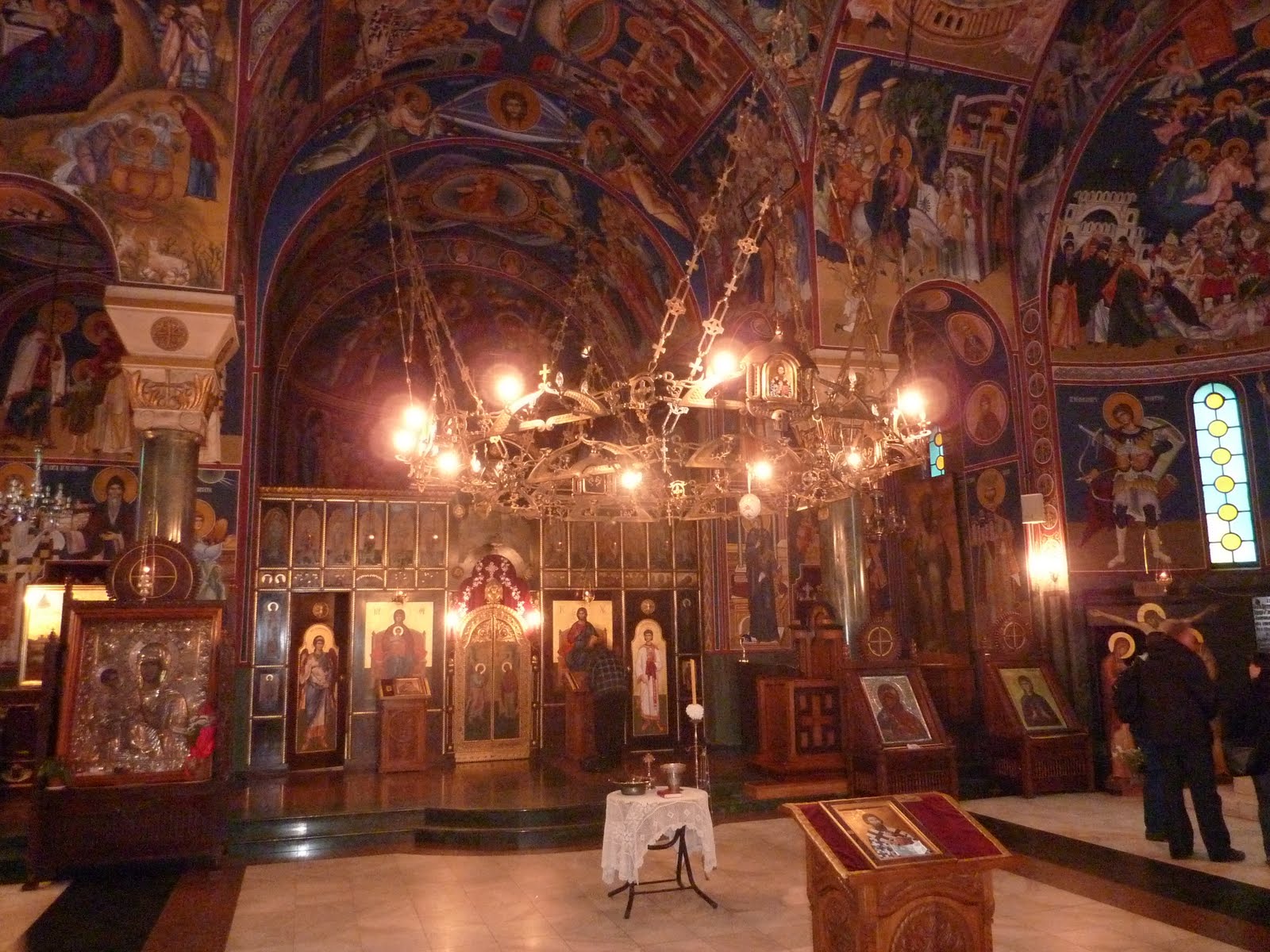
We visited the Orthodox Cathedral, which was beautiful. We tried to visit the Catholic Cathedral too, but this was locked! Outrageous. There is a definite cafe culture in Sarajevo - the locals appeared to love nothing more than meet up with friends for a coffee and there are plenty of quality cafes to choose from. So we joined in and had a coffee and rested our legs while we planned our next move. After some more exploring and looking at shops, we grabbed some lunch at a place on Bravadziluk street, an amazing street in the Old Town packed full of eateries. We both had a Bosnian favourite dish for lunch, called "cevapi". It is a Turkish bread pocket, packed with little lamb sausages and onion and some yum yum sauce (see photo of Tim tucking in, below). Seriously delicious. The Balkans do meat and bread pretty well, but this little Bosnian delight was probably our favourite!
After lunch we had our Sarajevo War Tunnel Tour. A bus picked us up from the river bank in the Old Town and took us out to the location of the War Tunnel, near Sarajevo's airport. We arrived at a house on the outskirts of the city, behind the airport and we were ushered inside and into a room that has been decked out as an underground war bunker. Our guide told us all about the siege (not a war we were told, as the Bosnians had almost no weapons and were brutally massacred - a war usually indicates that two sides are fighting). She was about 14-18 years old during the siege, so she could give us an insight to what it was actually like.
Sarajevo was surrounded by Serbian forces, who cut off electricity and water supply for much of the four-year siege. The Serbs also cut off supplies of food and medicine initially, although once NATO took control of the airport, some of the food and medicine that was sent to Sarajevo made its way to the Sarajevans - some was dished out to the Serbian soldiers! NATO and the West in general appear to have made an appalling effort at assisting Bosnia during this siege. Initially the West did not want to get involved - the story goes that the West either did not know what was happening, or decided that it was not for them to get involved. Eventually the decision was made to send in unarmed NATO troops, purely as peace-keepers. All this did was to further handicap the Bosnians, as NATO confiscated what few weapons the Bosnians had to defend themselves with and then NATO failed to provide the protection the Bosnians needed. Plus, as time went on, some of the NATO troops were killed by Serbian forces too. The Serbs had taken the hills that surround Sarajevo and their snipers would pick off Sarajevans in the streets of the city. They also fired shells at buildings, cars, etc, which resulted in dozens of buildings catching fire and being destroyed.
Our guide told us of the determined defiance of the Sarajevans. They could do little to stop the siege, but they were determined to continue their lives as best they could and not let their spirits be broken. An untapped strength and creativity was expressed through the war theatre in Sarajevo, which put on plays for the duration of the siege - often portraying actual incidents from the siege in a humorous light. The newspaper, "Oslobodenje", meaning Freedom, did not miss a single day of print despite the lack of paper and supplies. Cultural life did not die during these times, it flourished in the most defiant form of non-violent resistance. Bosnians walked through the hail of gunfire to have coffee with a friend and they even held a Miss Sarajevo beauty pageant in a basement during one of the worst periods of the war - the inspiration for U2's song "Miss Sarajevo". Our guide told us of one occasion where she and "what is now her husband" as she described him, were in an underground theatre watching Schindler's List, thinking about how terrible and tragic it all was, and they had the same thing going on above ground!
Sarajevans were so desperate to get food and supplies into the city from other parts of Bosnia that men would attempt to run across the fields alongside the airport runway (carrying huge sacks of supplies) in the middle of the night. This was successful to a degree, although many men were shot dead in the process. So, they craftily devised a plan to dig a tunnel in order to link the city of Sarajevo, which was entirely cut-off by Serbian forces, with the supposedly neutral area at the Sarajevo airport set up by the United Nations. The starting point of the tunnel was at a family home (the venue of our "tour"). The tunnel took around 4 months to create, from January 1993 to May 1993. It was 800m long and 1.5m high. The tunnel allowed food and humanitarian aid to come into the city, and people to get out. During the time it was used, it is estimated that 20 million tonnes of food entered the city, and one million people passed in and out of it. It was also one of the major ways of bypassing the international arms embargo, which had crippled the Sarajevans' ability to defend themselves. In effect, the tunnel saved Sarajevo.
After hearing all about the siege and the tunnel from our guide, we watched a short video of footage from the siege, which was quite horrific. Then we walked through the small section of the tunnel that still exists. The outside of the house that is now the museum for the war tunnel, is scarred with dozens of bullet holes (photo below).
After the tunnel tour we had a bit of rest back at the hotel before joining our walking tour of the Old Town. It turned out that we had the same tour guide from the tunnel tour for the walking tour. The 90-minute walking tour was fantastic. We covered the main mosque, the synagogue, the Orthodox Church and the Catholic Church (which was open this time!). Our tour guide pointed out the "red roses" on the pavements and roads all over the city. These are spots of red paint or wax that look a little like roses that have been painted onto the pavements etc in spots where people were killed during the war. Once she had pointed them out to us, we started noticing them everywhere - quite horrific. We also re-visited the spot where Franz Ferdinand was assassinated, the Bey Bezistan indoor marketplace, the Morica Han caravan palace (the function of this was to provide warehouse space, stables and accommodation for traders passing through Sarajevo - it is now filled with shops and eateries downstairs and offices and accommodation upstairs), the Gazi Husrev high school (Gazi created quite a few cool things in Sarajevo, including the main mosque!), the City Hall and numerous other interesting sites along the way. Our tour guide also informed us that Bosnia's flag, which is a little unusual, was based on the European Union flag, as they couldn't agree on a design of their own when they gained independence.
After the tour ended, we stopped for a coffee and then walked down the Mula Mustafe Baseskije (the main street running along side the Old Town), past the Markale outdoor marketplace, the scene of the "Markale massacres", two artillery attacks by Serbian forces on civilians during the Bosnian War. The first attack happened on February 5, 1994 when 68 people were killed and 144 more were wounded. The second occurred on August 28, 1995 when a mortar shell killed 37 people and wounded another 90.
We continued on to the Eternal Flame monument commemorating the military victims of World War II. Then we stopped in at the Zlatna Ribica bar, one of Sarajevo's most famous bars. The name means "Little Fish" and there are opera, theatre and concert posters lining the walls. The decor is a cross between a mini-brasserie from Paris and a Viennese coffee house. We had a couple of drinks in there and enjoyed the "interesting" collection of music.
It was a lovely warm evening, so we walked back into the centre of the Old Town and watched the Brazil v Chile football match at an outdoor sports bar that had very cheap drinks, and then we returned to our favourite food street and had some delicious Bosnian treats for dinner.
Tuesday
After the hotel breakfast, we ventured down to the Old Town and visited the Gazi Husrev Begova Mosque, Sarajevo's largest and most signifiacnt mosque. The mosque is probably the finest example of Ottoman Islamic architecture on the Balkan Peninsula. The original structure was built in 1530 but it was destroyed and rebuilt a few times before the last reconstruction in 1886.
Our second stop of the morning was the Sarajevo Museum, which was really interesting. We enjoyed finding out a lot more about the history of the city and its settlers right through from antiquity through to the end of the Austro-Hungarian Empire around World War I.
We had morning tea at the Ramis coffee shop, which consisted of the most delicious hot chocolate and an amazing slice of chocolate cake (see photo below). We enjoyed sitting outside and watching the Sarajevans go about their business. Then we visited one of Sarajevo's famous sweet shops. Megs bought a supply of turkish delight that could sink a battleship and Tim bought an equally enormous bag of chocolate-covered hazelnuts.
Around midday we caught a taxi out to the Historical Museum of Bosnia and Herzegovina, about a five-minute drive from the Old Town. The building that houses the museum was badly damaged in the siege - the bullet holes are still visible in the walls. The building now houses the permanent exhibition entitled "Surrounded Sarajevo". The exhibition looks at the nearly four years of war on the city's citizens. It is presented in a non-partisan and non-judgmental fashion, through photographs and artifacts, many of which have been supplied by the citizens of the city themselves. There are some horrendous photos of the siege and certain parts of the exhibition are particularly harrowing. There is a section that looks at the effect of the siege on children, which includes blood-stained workbooks and satchels from a classroom where snipers shot and killed a school teacher and three pupils, injuring many more, during a school lesson. We learned so much about the war - we knew very little before actually visiting Sarajevo!
We treated ourselves to a trip back into the Old Town on a very crowded tram before visiting the city's brewery for a drink of the local Sarajevsko beer! There was a hilarious sign on the front door of the bar attached to the brewery that stated that Diners Club and American Express cards were welcome but that guns were not allowed (see photo below).
The rest of the afternoon was very relaxing - we wandered through the Old Town again and visited a traditional Bosnian cafe that served coffee and tea and specialty cakes just like they had in the "olden days"! The sun came out and it was a fantastic hot, sunny afternoon.
We had dinner at a lovely place down a side alley off the main Old Town drag of Ferhadija. We ate a selection of Bosnian delights on a platter, which included cheese and doughnut-type things on lettuce, some stuffed peppers, mince meat wrapped in cabbage, meat balls, potatoes and stuffed onions. The food was generally very cheap in Bosnia. We got an ince-cream for dessert on the way back to our hotel and we watched Spain beat Portugal 1-0 in the World Cup before getting an early night.

Bascarsija

Cobbled
streets of
the Old
Town

Megs on
Ferhadija

Cathedral

Bravadz-
(food street)

Tim eating
his cevapi

Old
Town

Bascarsija

War Tunnel
Museum

Megs in the
tunnel

Franz Ferdinand
assassination
museum

Tim by
the river

Zlatna
Ribica
bar

Bravadz-
by night

Pretty
Sarajevo


Megs in
"Treasure
Alley"

Inside a
handcraft
shop

the mosque


Old Town
again

Megs with
our delicious
morning tea

No guns
allowed

Delicious
Sarajevsko
beer